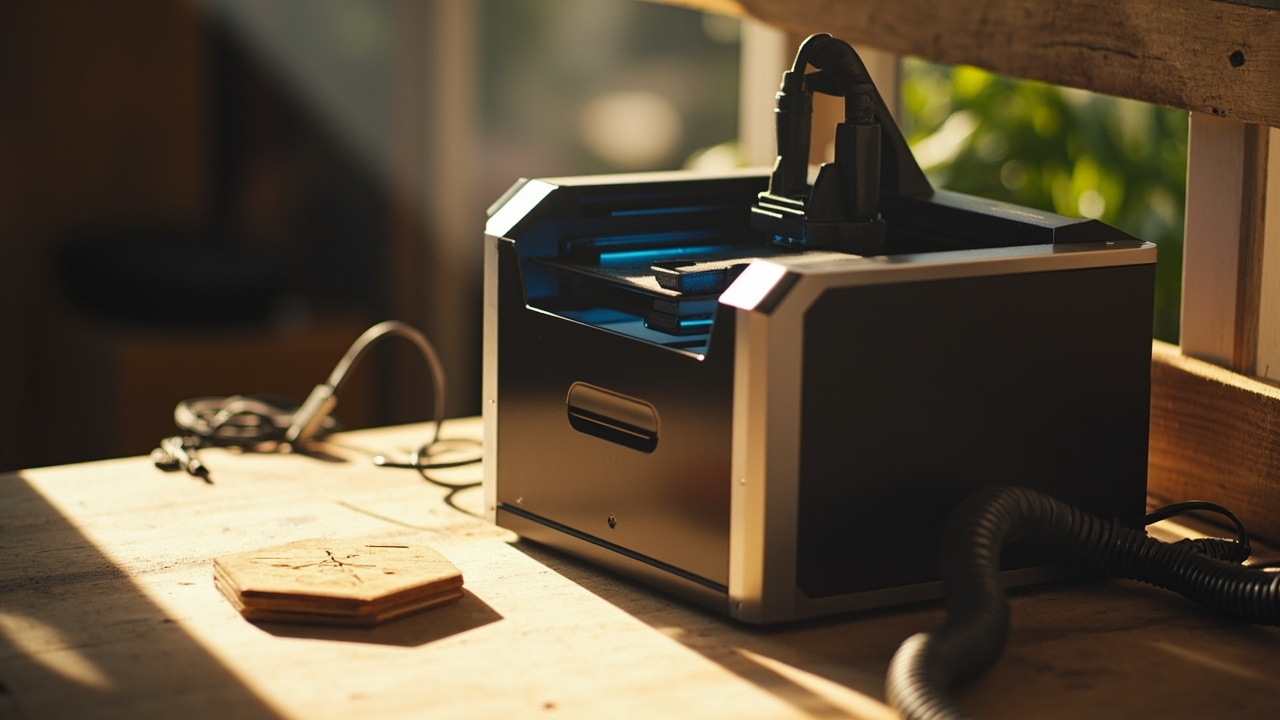
Consumer laser engravers have dropped in price while improving in capability. The Creality Falcon A1C enters the market at $299 with a 10W laser module, built-in camera for positioning, and support for materials ranging from wood to metal. The hardware impresses. The software experience reveals why this category still has room to mature.
What's in the Box
The Falcon A1C comes ready to use. Included are a safety key, USB-C cable, exhaust tube with hose clamp, power cable, and the laser module. No screen adorns the unit—everything happens through the mobile or desktop app. The 150x150mm working area is compact, suitable for small projects but limiting for larger work.
The Hardware
Setup is straightforward: connect via USB-C, position your material, and start a job. The built-in HD camera takes a photo of the work area, which the software uses for visual positioning. This works well for flat items where alignment matters.
The laser module produces clean cuts through wood, leather, and acrylic. Metal engraving works on anodized aluminum and similarly coated surfaces. Stone and glass require multiple passes. The machine moves at speeds up to 15,000 mm/min, quick for this class of device. A rotary attachment (sold separately) enables cylindrical engraving for mugs and similar items.
The Software Problem
Creality provides both mobile and desktop apps. Neither is polished. The desktop version is more usable, but both suffer from interface inconsistencies and unintuitive controls.
The mobile app requires a background photo approach for positioning that lacks opacity controls. Placing a white-background image on a blank material means you cannot see the material underneath. The AI cutout feature works but leaves backgrounds opaque when transparency would be more useful.
Line drawings engrave better than photographs. The software includes a line-drawing filter for converting photos, which improves results significantly on photographic sources.
Who Should Buy the Falcon A1C?
| Good fit | Not ideal |
|---|---|
| Beginners exploring laser engraving as a hobby | Users needing bulk production capabilities |
| Simple line-art and text projects | Complex photo-realistic engravings without effort |
| Makers with basic ventilation (cracked garage door works) | Indoor use without external exhaust setup |
| Those comfortable troubleshooting software quirks | Users wanting plug-and-play simplicity |
Our Analysis
Creality has built a capable engraver at a competitive price. Hardware quality matches or exceeds expectations for the money. The software is where the experience stumbles.
This is common in the consumer laser category. Hardware iterations arrive faster than software refinements. The real question is whether the hardware foundation justifies living with workflow frustrations until updates arrive.
What to watch: Creality's update cadence for the mobile and desktop apps will determine whether this device becomes a long-term recommendation or a hardware-only success story.
Bottom Line
The Falcon A1C is worth considering if you're willing to work around software limitations. For simple projects and line-based designs, it performs well. For photo-quality work, expect adjustment time.
Key takeaways
- Hardware punches above its price point
- Software needs refinement; desktop app is more reliable than mobile
- Line drawings work better than photographs without the line-drawing filter
- Small 150x150mm working area limits larger projects
- Best for hobbyists and beginners, not production environments
Frequently asked questions
Can the Falcon A1C cut through thick materials?
Cutting ability depends on material and laser power. With the 10W module, thin plywood and acrylic cut cleanly.
Is eye protection needed?
Yes. Never look directly at the laser during operation, even with the built-in enclosure.
How noisy is the exhaust fan?
The included fan is audible but not excessively loud. Connecting to stronger external ventilation improves air quality during extended use.
What materials can it engrave?
Wood, leather, acrylic, metal, stone, and glass are supported. Results vary based on material density and surface coating.